
Power County Scheduled or Actual
A projected date is a forecast or legal milestone. An actual release date records a completed custody event. Idaho does not place one generic projected-release field on every IDOC record. Instead, a detail may show Parole Eligibility Date, Next Parole Hearing Date, Tentative Parole Date, Sentence Satisfaction Date, or Retained Jurisdiction End Date. Each label has a narrow meaning.
A Power County detainee awaiting trial usually has no fixed release date. Bond may authorize release, but detention staff must finish processing and check other holds. A judge's order and physical exit can occur at different times. A county sentence is computed from the judgment and lawful credit. State prison terms are calculated by IDOC Sentencing Records.
Find Power County Release Dates
First decide whether Power County, IDOC, federal authorities, or another agency holds the person. The Power County Current Bookings roster shows only people listed now. Absence does not prove release. State sentence and parole milestones belong in the IDOC Resident and Client Search.
- Match the person by name and birth year, booking number, or IDOC number.
- For a local case, read the court judgment and ask detention whether the person is presently held.
- For an IDOC client, open every sentence row and preserve the exact date label, status, and update date.
- Review Commission action if parole is involved. A favorable result remains prospective.
- After the expected day, confirm the actual event through IDOC, detention, VINE, or a records request.
The Power County released inmate search gives the full path after a local name drops from the roster.
Idaho Release Date Calculation
Idaho uses a unified sentence with fixed and possible indeterminate parts under Idaho Code §19-2513. The fixed term is the minimum custody part. The indeterminate term is the possible balance during which parole may be considered. PED generally marks the start of that second part. It is not a release command.
Idaho must not be reduced to an “85 percent” shortcut. Ordinary parole or routine good-conduct reduction is unavailable during the fixed portion. Idaho Code §20-101D creates a narrow, discretionary reduction for exceptional meritorious service. It is not normal good time and may be withdrawn.
The official IDOC Sentencing Records unit reviews judgments, applies jail and retained-jurisdiction credit, calculates terms and eligibility dates, and keeps sentencing records.
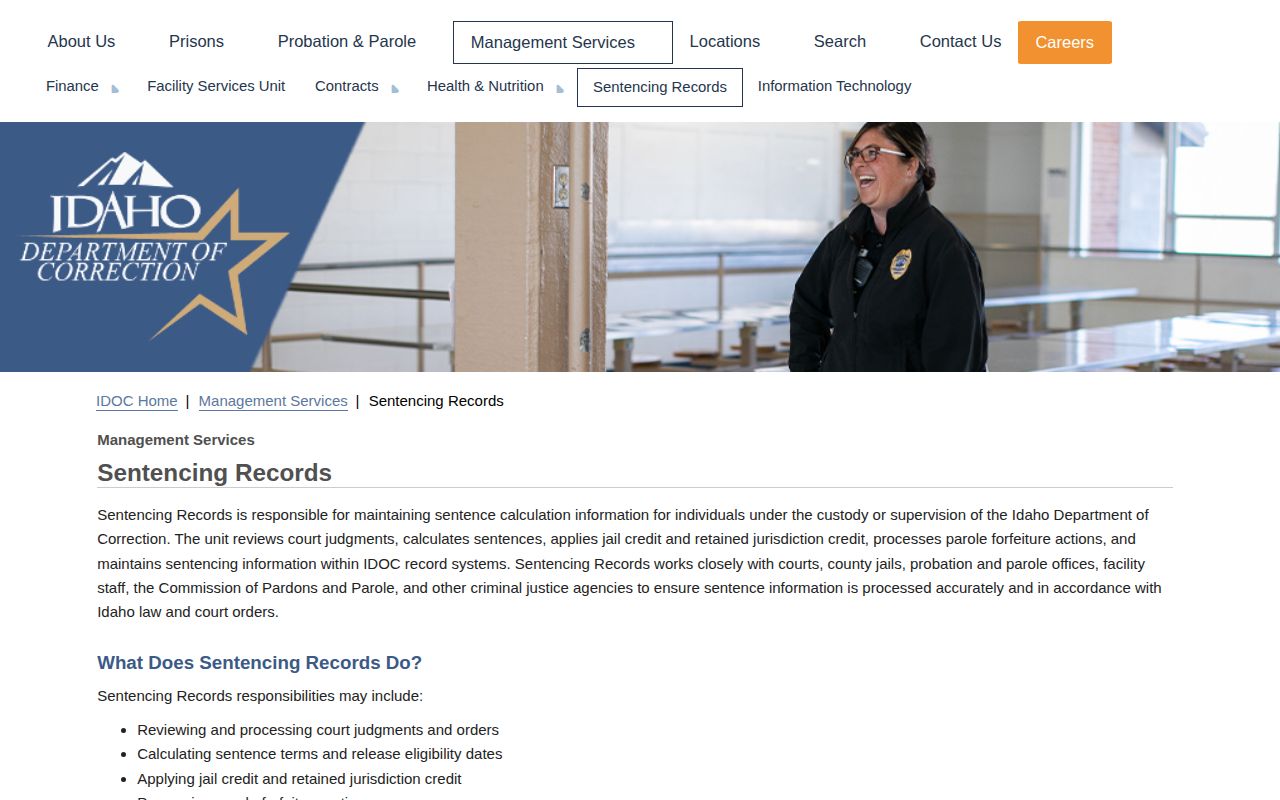
This agency source shows why an official calculation or correction should go to IDOC, not an unofficial date formula.
Why Power County Dates Change
Even a date copied correctly can move. Multiple sentences may run together or apart. A later court order can alter the judgment. Another authority may lodge a detainer, which is a request to hold or transfer the person. Parole depends on more than a favorable board action.
| Factor | Possible effect |
|---|---|
| Corrected judgment or credit | IDOC or the jail recalculates from the court record. |
| Multiple sentence rows | The controlling term may extend the endpoint. |
| Parole decision | A grant, denial, or deferral changes the path, not proof of exit. |
| Program or plan approval | A tentative date may move if required steps remain. |
| Detainer or new order | Release from one agency may become a transfer. |
| Exceptional credit withdrawal | A narrow reduction may be changed under its rule. |
Confirm Power County Actual Release
A parole notice may say granted, denied, or deferred. A tentative date still depends on reaching PED, finishing required programs, approval of a release plan, transportation, and a signed contract. Do not describe the person as released because that day arrived.
Use the VINELink Release Check for an alert, then compare it with IDOC's later In community and Released to Supervision fields. Full-term completion may later appear as Discharged with a date. For a local jail event, call 208-226-2311 and request the existing release sheet for actual date, time, type, and receiving authority where releasable.
Power County Parole Milestones
PED, a hearing date, and a tentative parole date are separate milestones. Initial hearings are often set before PED, but a hearing is not release. Sentence Satisfaction Date is the full-term endpoint on a sentence row. A historical Discharged date is stronger proof of completion than any earlier forecast.
When several rows appear, do not select the first date without reading status and county fields. Ask IDOC Sentencing Records about conflicts. If the issue is the judgment, use Idaho iCourt and the Power County clerk. Accurate date work preserves the label, source, and “as of” time.
Power County Date Field Meanings
PED is the first point for parole consideration. Next Hearing schedules a proceeding. Tentative Parole Date is conditional. Sentence Satisfaction Date is one row's full-term endpoint. Retained Jurisdiction End Date belongs to a distinct Idaho process. None should be relabeled without context.
| Field | Supports | Does not prove |
|---|---|---|
| PED | Eligibility | Release |
| Hearing | Planned review | Outcome |
| Tentative date | Conditional target | Exit |
| Satisfaction | One term's end | No other term |
| Discharged | IDOC completion | Local booking facts |
Released to Supervision is a placement, not the end of every duty. Preserve all rows.
Power County Jail Date Requests
The roster gives intake and case fields but no out date. A vanished name proves only absence from the current list. The person may have bonded, served time, transferred, moved on a hold, or had a record corrected.
Call detention, then use the county records request. Give identity, booking number, date, and a bounded range. Ask for actual date and time, type, authority, and destination where public. Compare the result with the court docket because legal authority may precede physical processing.
Power County Transfer Dates
A transfer is an exit from one facility, not always community release. IDOC, another county, federal authorities, and immigration custody each require a separate official channel.
Systems post on different clocks. Record each source date. Use “transferred” when the record supports it, and reserve “released” for an affirmative community event.
Power County Unified Sentences
A unified Idaho sentence contains a fixed part and may include an indeterminate part. The judgment controls both. The fixed term sets the minimum custody period before ordinary parole can begin. The possible balance extends to the maximum. PED commonly aligns with the start of the indeterminate part, though multiple sentences can make a later date control.
This explains why sentence length cannot be turned into a sound date by subtracting a standard percentage. Exceptional meritorious service addresses rare specified conduct, caps eligible reduction, excludes life terms, and allows withdrawal. It is special and discretionary, not routine credit.
Jail and retained-jurisdiction credit depend on judgments and records. IDOC Sentencing Records applies them and handles parole forfeiture. If the detail conflicts with the judgment, request official review. Do not recalculate from memory.
Power County Tentative Parole Dates
A grant creates a path, not a completed event. The person must reach PED, finish programs, obtain approval of the plan, arrange transport, and sign the parole contract. Any unfinished step can delay or void the target.
Review the Commission action, then return to IDOC. In community plus Released to Supervision is stronger evidence that parole began than an earlier grant. VINE adds an event source but does not prove every hold ended.
If a tentative date passes while status remains In custody, verify. Programming, plan approval, a detainer, a court order, a later action, or update lag may explain it. Only the agency can identify the cause.
Power County Full-Term Release
Sentence Satisfaction Date is the full-term endpoint on one sentence row. It differs from PED and tentative parole. Multiple rows require checking whether another active term continues beyond it.
After completion, IDOC may retain a name with Discharged and a date while omitting convictions from that historical result. Use iCourt and the Power County clerk for the case if public. Ask the last district about a Gold Seal when an official completion paper is needed.
For a county jail sentence, request the sheriff's release sheet with the judgment and credit order. County, IDOC, federal, and immigration discharges remain separate events.
Power County Date Audit Trail
Record each exact label, value, system, identifier, and time checked. Save the case or booking number because names repeat and interfaces update.
- Use the roster only for current local listing.
- Read judgments and later court orders.
- Read all IDOC sentence rows.
- Check Commission action for parole.
- Use VINE for an event, then confirm.
- Request the release sheet or calculation when needed.
This separates forecasts from proof and distinguishes leaving a jail, transfer, supervision, and sentence completion.
Power County Court Date Limits
A bond amount on the booking detail is not a scheduled release date. Payment may satisfy one release condition, yet staff must confirm the order, complete processing, and check for other holds. A pending local case also continues after bond. Describe the event as release from jail on bond, not dismissal or sentence completion.
A judgment can show jail credit or a commitment that helps explain the expected custody path. Later amended judgments, violation orders, or warrants can change it. Search Idaho iCourt with the exact case number. If the public portal does not supply the needed document, ask the Power County clerk for the accessible judgment or order. Court records outlive many roster entries, but they may not state the moment of physical exit.
Power County's Magistrate Court handles misdemeanors and lists adult arraignments on its local schedule. District Court handles its assigned felony and district matters. The distinction helps route a question, but the filed case controls. Use the docket's court and case number rather than guessing from the charge label.
Power County VINE Date Alerts
Idaho VINE can add a notification layer for a specific person. Search the individual, verify identity, and register for the offered event methods. A release alert reflects an event reported by the participating feeder. It is not a certified sentence calculation and does not show that supervision, a detainer, or another authority ended.
Keep a second channel. IDOC documented a VINE interruption and restoration in 2024, and any automated system can lag its source. For a local person, compare the alert with detention and the release sheet. For a state client, compare it with IDOC status and sentence rows. The VINELink Release Check explains phone, text, and email registration.
When VINE has no result, retry name variants and confirm identity. Absence is not a release conclusion. Use the roster, court, IDOC, direct phone contact, and a narrow records request until an official record settles the event.
Sources reviewed July 16, 2026.
Public Record Search
Sponsored Results